



Kẹp giữ sợi Filament
 Bytinx_1344834Likes1.2KDownloads6K
Build another version of this model.
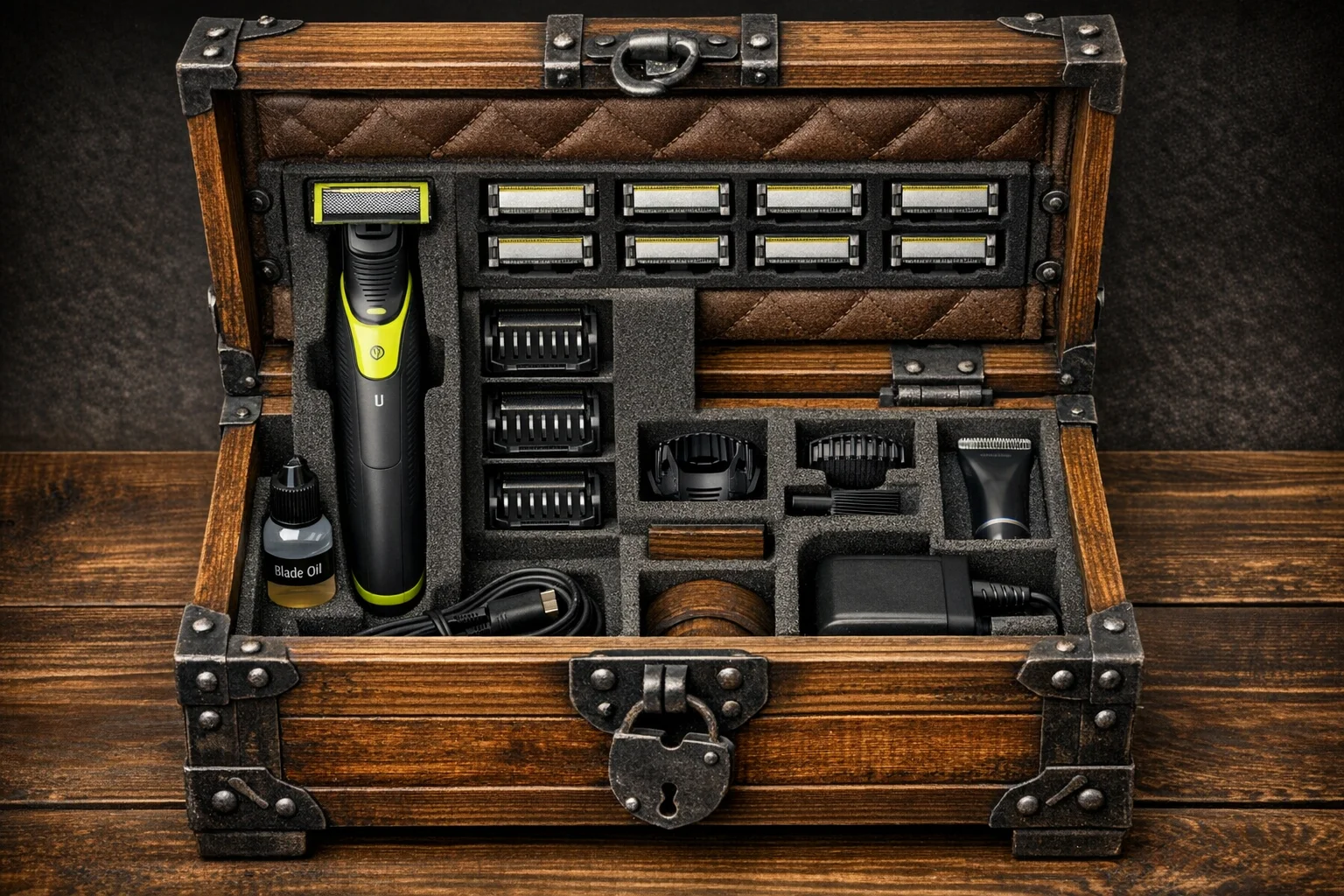
The Chest of Jan Holič, Barber to Charles IV
Old men in the taverns of Rattay and Sasau still lower their voices when they speak of Jan Holič, the royal barber who once served none other than Charles IV, King of Bohemia and Holy Roman Emperor. They say there was a time when blades at court were feared less on the battlefield than in the king’s own chambers – and Jan’s razor was the sharpest of them all.
Jan began as a clever village lad with a steady hand, plying his trade in baths and taverns. A lesser noble took notice, and soon lords were seeking him out not just for smooth cheeks, but for a listening ear. Men will confess their souls to a barber’s mirror: they grumble about unpaid debts, whisper of forbidden books and dangerous preachers, brag of secret lovers, and curse rival lords. Jan listened, remembered, and spoke little. That made him valuable.
By slow degrees, Jan rose through noble households until at last he was summoned to serve at Prague itself, within the orbit of Charles IV. The Emperor was a pious and learned man, but also a ruler surrounded by factions – German courtiers, Czech nobles, churchmen, merchants – each tugging at the kingdom from a different side. In such a court, a man who shaves the Emperor’s throat stands closer to power than most princes.
According to the whispers, Jan was approached by men whose cloaks were fine and whose Czech was stiff and awkward – more used to German and Latin than the speech of common folk. They did not openly threaten him; they didn’t need to. They spoke of the Empire’s future, of Charles’s plans, of the balance of power between Prague and distant lands. Some say they bore the favor of high princes, others blame ambitious lords of the realm. All stories agree they made Jan an unholy offer:
Gold enough to disappear. Protection for his kin. A quiet life somewhere far from Bohemia’s storms. All he had to do was let his razor slip.
No chronicle in Charles’s grand Golden Bull nor in the accounts of imperial scribes records any such treachery. Officially, Charles IV died in 1378 from his long-standing infirmities, worn out by age and rule. Priests wrote of a Christian death; nobles spoke of God’s will; Prague mourned.
But the taverns never trusted what was written in fine Latin.
They tell it this way: on one of the Emperor’s last mornings, when his body was failing and his breath came hard, Jan was summoned. Charles wished to be made presentable, as he had ever been – clean beard, trimmed hair, a king to the end. Jan lathered his throat, the gray-bearded sovereign sitting with weary dignity.
Perhaps Charles spoke kindly to him; perhaps he confessed doubts about the succession, about his son Wenceslaus IV, about the unity of Bohemia and the Empire. Some versions say Charles spoke of visions of Prague’s future—unrest, sermons, fire. Jan’s hands trembled as he laid steel to royal flesh.
Then, in the hushed warmth of the chamber, the razor slipped.
There was a sharp breath, a wet sound, a spray of blood over linen. Servants burst in to find the Emperor slumped, blood at his throat, the barber staring as though turned to stone. The royal physician and priests hurriedly tended the body, and by the time the sun fully cleared the roofs of Prague, Charles IV was dead.
To the world, it was the end of a long illness. To a handful of terrified witnesses, it looked like something else entirely.
What became of Jan is the heart of the gossip:
Some say he was seized at once, questioned in secret by men loyal to the crown, then quietly hanged in a hidden yard of the castle, his body buried without a name.
Others claim the very men who had approached him before smuggled him away, fearing what he might say under torture.
In the darkest telling, Charles did not die immediately. With blood on his lips, he gripped Jan’s wrist and whispered something only the barber heard – words that turned Jan’s hair white within a night.
Whatever the truth, Jan Holič vanished. With him disappeared a small oaken chest bound in iron – the humble traveling chest of a royal barber.
At first glance, it was nothing special: a sturdy box with razors, combs, shears, ointments, and cloths. But those who knew Jan say he always kept more inside:
Sealed scraps of parchment bearing fragments of noble correspondence,
impressions of signet rings pressed in spare wax,
a square of linen stained with the blood from Charles’s final shave,
and, so the tales insist, a written account by Jan’s own hand – a secret confession naming those who came to him and what they asked him to do.
That plain, workman’s chest became known in whispers as the Chest of the Royal Barber.
When Wenceslaus IV took the crown, he inherited his father’s cities, crowns, and enemies – but not the truth about Charles’s final morning. If the stories are to be believed, even Wenceslaus has never known whether his father truly died of sickness… or of a traitor’s slip of the blade.
Some say men loyal to Wenceslaus have hunted for the chest, hoping to prove his father was murdered and rally the realm around his memory. Others say enemies of the king have sought it too, eager to expose Charles’s death as scandal or to show that Wenceslaus sits on a throne stained by secret treachery.
Years later, as unrest grows, sermons ring from pulpits, and Bohemia trembles between crown and chalice, the rumor persists across Rattay, Sasau, Talmberg, Prague, and Kutná Hora:
Somewhere – in a forgotten loft above an old bathhouse, in a ruined townhouse once owned by a court physician, or in the sealed cellars of a city house tied to imperial servants – lies the Chest of Jan Holič, still holding razors gone dull with age and papers that could unravel an emperor’s memory.
To the common folk, it is just a fireside story – something to mutter over ale when speaking of kings and their strange fates. But to those who live and die by secrets in Bohemia, the chest is more than a legend. It is proof that even a man as great as Charles IV might not have died as the priests and chroniclers claim.
And somewhere in Prague or beyond, his son King Wenceslaus IV rules on, burdened enough by his own failings and his nobles’ scorn, never knowing for certain whether his father passed peacefully by God’s will… or bled out under a barber’s shaking hand, his last breaths locked away forever in an old, iron-bound chest.
Bytinx_1344834Likes1.2KDownloads6K

 Bygummiegecko8477Likes0Downloads168

 BydalleLikes0Downloads150

 Byarhi_585078Likes64Downloads546

 ByHanzo3dLikes155Downloads417

 ByGeek5DLikes147Downloads490

 ByBrokentooth_designsLikes23Downloads412

 Bycrawler-3903250Likes0Downloads909

 By3DSourcererLikes48Downloads381

 Byartme-3dLikes0Downloads336

 Bybloblis67Likes0Downloads320

 Byprusa-researchLikes0Downloads2.7K