


Kẹp giữ sợi Filament
 Bytinx_1344834Likes1.2KDownloads6K
Build another version of this model.
Attention:
These files are for version MK3.9. Please check which hardware you have!
Please read these instructions completely and carefully. The requirements must be followed therwise the function of the extruder may be impaired.
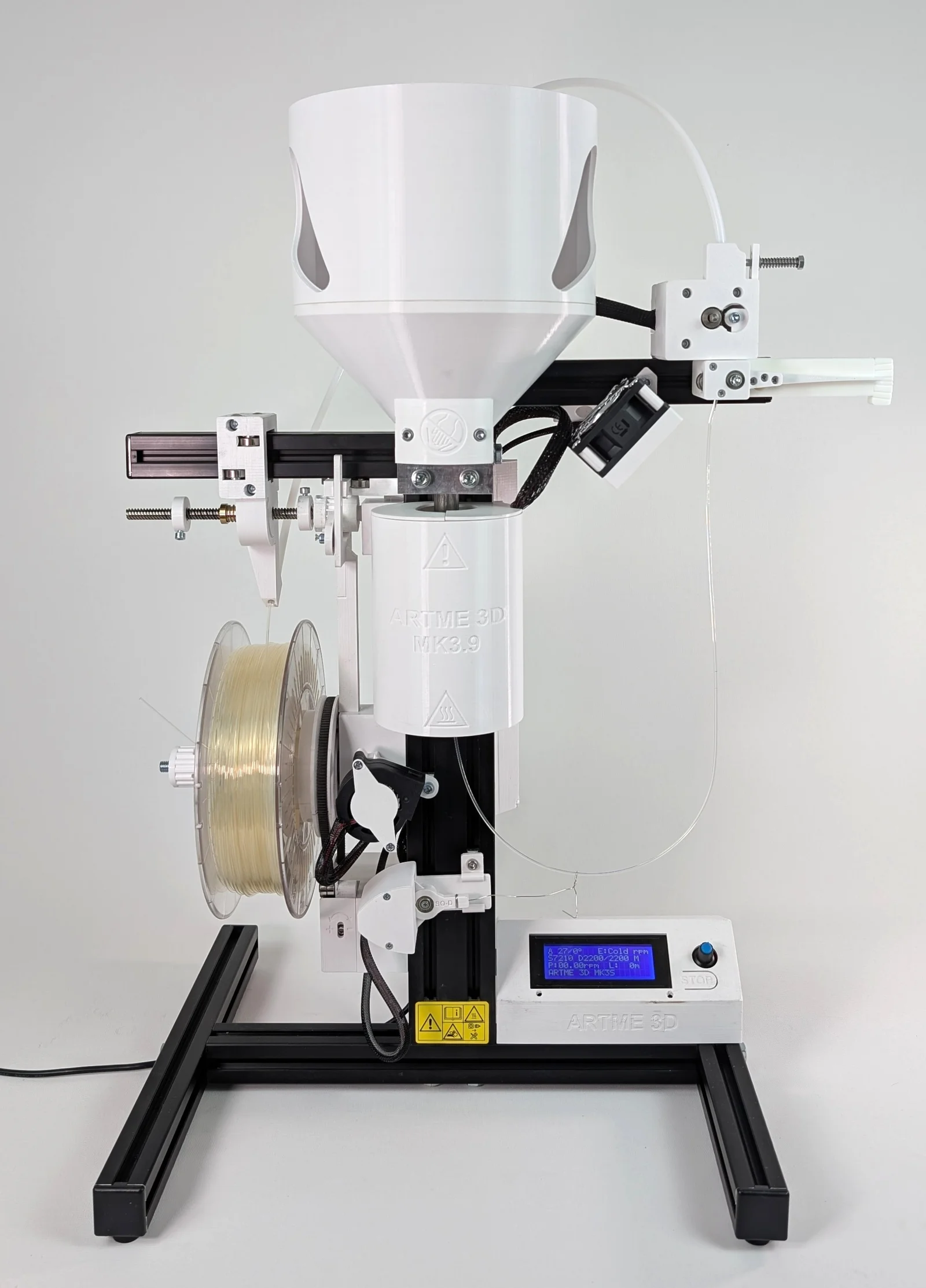
The Original Desktop Filament Extruder MK3.9 is a complete kit from ARTME 3D® Home - ARTME 3D (artme-3d.de). The kit is supplied with all the necessary components. Only the 3D printed parts need to be printed yourself and some tools are needed.
Difference to the previous model:
The main reasons for the switch to version MK3.9 were availability issues with certain parts and price pressure from increasing competition. However, this opportunity was also used to implement design improvements, such as increased cooling capacity and reduced wear on moving parts. A new type of dosing hopper improves and expands the processing of pellets with a wide range of consistencies.
The MK3.9 is plastic extruder in an unbeatably small but powerful design for the production of 3D printer filament. The extruder works with a stainless steel extruder-screw with compression zone. There are two different extruder-screws inb the kit. This allows the extruder to process commercially available plastic pellets and also regrind from 3D printer waste. The filament produced is wound directly onto a spool. And all this with a footprint of just 430 mm wide and 330 mm deep.
Print order and settings:
Please see the PDF file in the “other files” down below. In this table, the order of the components is shown so that it corresponds to the assembly sequence. There you also find the settings and additional Informations like needed support structure or optional parts. The parts marked with PETG are subject to high mechanical and/or thermal loads during operation. These must be printed in PETG as a minimum.
Printer requirements:
The parts are only intended for FDM printing. The print quality and dimensional accuracy must be good. The printer must be well aligned and the axes must be at right angles to each other. The Z-seam must be of good quality and must not create holes or nubs on the surface of the parts, otherwise the function of the parts may be impaired and extensive reworking will be required. The print bed of the printer must be at least 200x200mm in size.
Find your way around the print files:
All 3D-printed parts have a unique designation as a combination of letters. The first two capital letters indicate the part group. For example: The two initial letters of the component ED-B are derived from the English "Extruder Drive". The breakdown of the parts for the "Extruder Drive" can then be found in the PDF files in the “other files” down below.
Color selection:
The choice of color is up to you. However, I find the color white the most stylish. In combination with the black aluminum profiles it looks like a real machine, in bright colors it looks more like a toy. The SO-D part must be printed in white (opaque, not semi-transparent) to fulfill its function, but this part is included in the kit from ARTME 3D®.
Printing time and material requirements:
The printing time can take up to several days. You should expect a material consumption of about 2.3 kg.
Optional components:
You must select the file that is suitable for printing from the files that contain the note "Option" in their part-name:
The ED-A part has a hole with a diameter of 12 mm. When FDM printing such a part, the hole is usually smaller than it needs to be. For this reason, there are several variants of the ED-A parts with a hole larger than 12 mm. For Prusa printers, the file with the 12.2 or 12.3 mm hole usually fits well. We need a loose fit. This means the parts must be able to move slightly during operation. If the hole is too tight and the part has to be forced in, it can negatively affect functionality. You need to know your printer.
For the SH-G part, you must select the part that matches the inner diameter of the filament spool you are using.
Print parts SH-C and SH-D if you want to produce 1.75 mm filament. Print parts SH-C-Option-2.85 and SH-D-Option-2.85 if you want to spool 2.85 mm filament.
Bytinx_1344834Likes1.2KDownloads6K

 ByRyanLikes0Downloads231

 Bycrawler-4460618Likes0Downloads170

 Bygummiegecko8477Likes0Downloads178

 Bychukwufumnanya-arinzechukwuLikes0Downloads160

 BydalleLikes0Downloads160

 BynasikLikes0Downloads127

 Byarhi_585078Likes64Downloads548

 ByHanzo3dLikes155Downloads418

 ByGeek5DLikes147Downloads493

 ByBrokentooth_designsLikes23Downloads414

 Bycrawler-3903250Likes0Downloads913