



Pocket-Size Third Hand Mini Spring Loaded Vise
 ByrjunLikes0Downloads310
Build another version of this model.
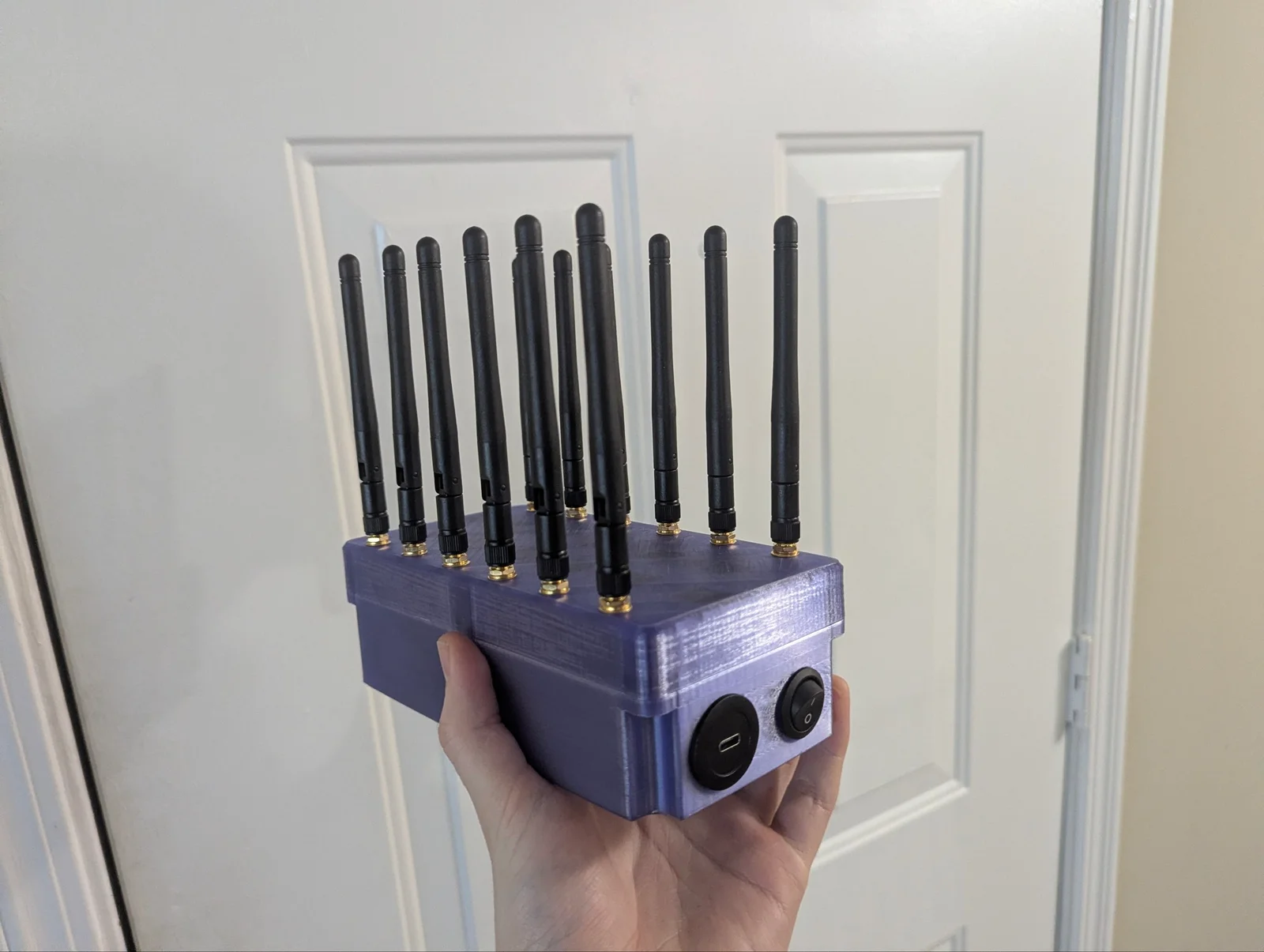
This is a container which holds twelve Seeed Studio XIAO ESP32-C5 microcontrollers, each with its own external antenna, as well as a battery. It is intended to be used for dual-band cluster wardriving.
The container's outer dimensions are 181.5 x 95 x 60 mm, not including I/O.
The base and lid assemble using six M3x8 screws, which thread from below into M3 heat-set inserts mounted in the lid. The inserts mount in the lid rather than the base so that the same lid can be used with multiple bases without needing to install additional inserts (and because I prefer the look).
Both parts should be oriented with the largest face down for printing. I recommend using supports for the screw holes on the base. The lid does not require supports.
My container was printed in Sunlu Transparent PETG on a Prusa MK4S. Transparent filament allows the indicator LEDs on the XIAOs and battery bank to be seen. PLA is not recommended due to its potential for warping when outside in the sun or in a hot car - use PETG or another filament with higher heat resistance.
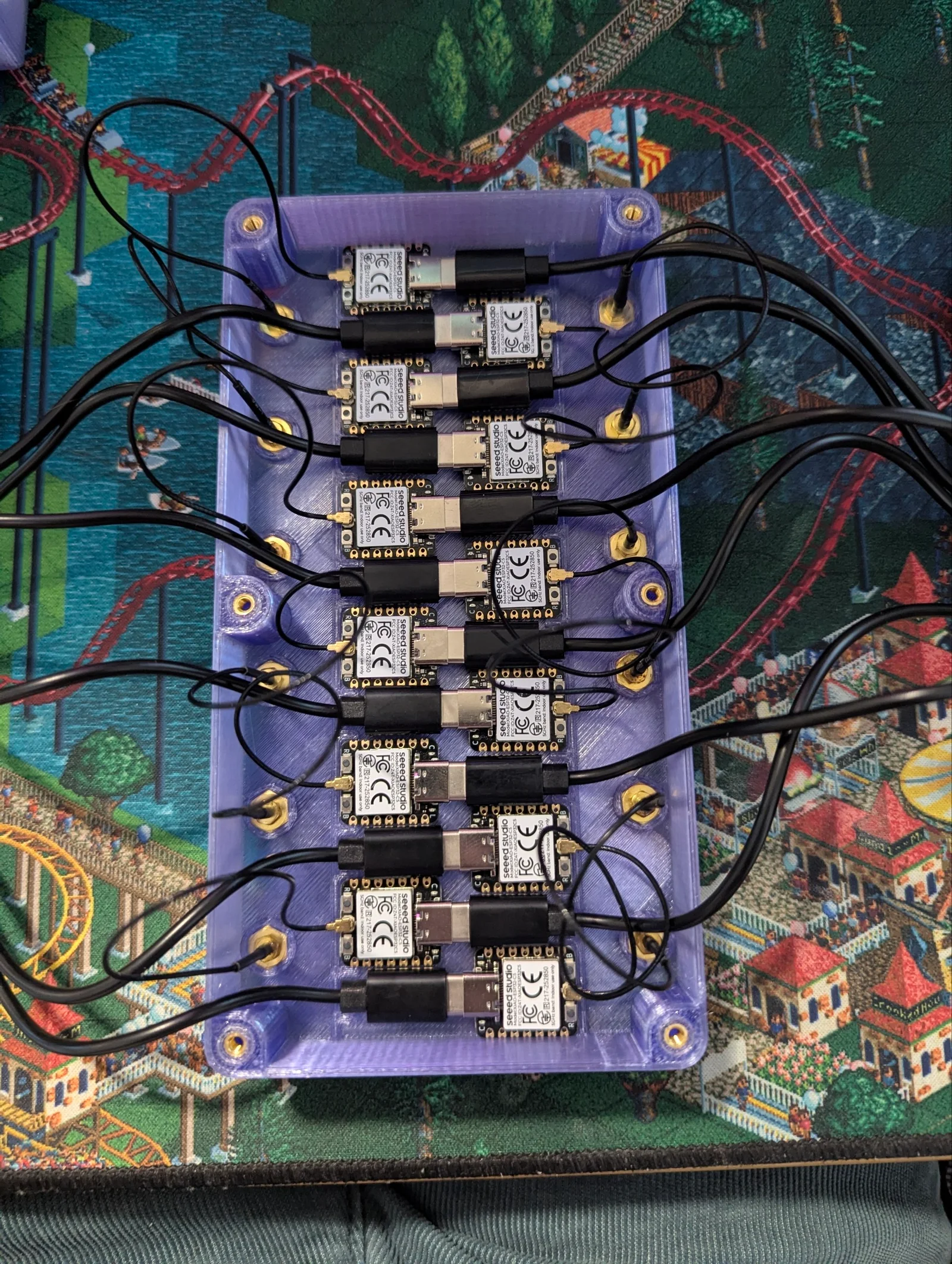
The XIAOs are mounted on the underside of the lid with VHB tape, and are each connected to an external Wi-Fi antenna terminal using U.FL to SMA adapters. Make sure to use the correct antenna adapters - antennas may be SMA (pin on antenna) or RP-SMA (pin on terminal), and each requires its own type of terminal.
The XIAOs are staggered and spaced to allow USB-C connectors with up to an 11mm housing. While it is possible to power all the XIAOs with a single USB cable by wiring their power pins together, I prefer to power each XIAO with its own USB connector so that assembly and part replacement are easier. Even if they will be wired together, this layout also has the benefit of allowing all the XIAOs to be reflashed without removing them from the lid.
The base was designed to contain two 1-to-6 USB-C splitter cables and an INIU P41L battery bank. Holes are included on one end of the base for both a 22mm⌀ USB-C connector to charge the battery bank, and a 20mm⌀ toggle switch, which is wired into the USB 5V line to act as a power switch.
I discovered in testing that the P41L seems to have some sort of auto-shutoff feature, so after being off for a while it will go to sleep and the toggle switch will not awaken it. Since I already have the battery bank and I don't want to modify it, I added small holes in the base's middle recesses, through which I can reach the battery bank's built-in power button and awaken it manually. Replacing the battery bank with a separate battery and charge controller would make this unnecessary.
An alternate version of the base is included without the external holes to make it easier to modify for different configurations.
Please note that a Biscuit Pro/Ultra, a JCMK C5 Wardriver, or another unit which can act as an ESP-NOW hub is required for the XIAOs to communicate with.
Designed with Onshape.
ByrjunLikes0Downloads310

 Bykonstantin-radchenkoLikes0Downloads162

 ByleonicLikes0Downloads1.4K


 ByZED4EverLikes313Downloads5.2K

 Byreinvent3dLikes0Downloads141

 BydcmtlLikes0Downloads128

 Bymrfixit_324954Likes65Downloads480

 Bylab-96Likes0Downloads110

 BymoonyxLikes0Downloads704

 ByVC_DesignLikes679Downloads3.6K

 ByDan Schwartz SchwartzLikes744Downloads3.4K