



Ke góc gia cố siêu bền Industrial Strength
 BySeppoTakaloLikes960Downloads1.9K
Build another version of this model.
Working principle
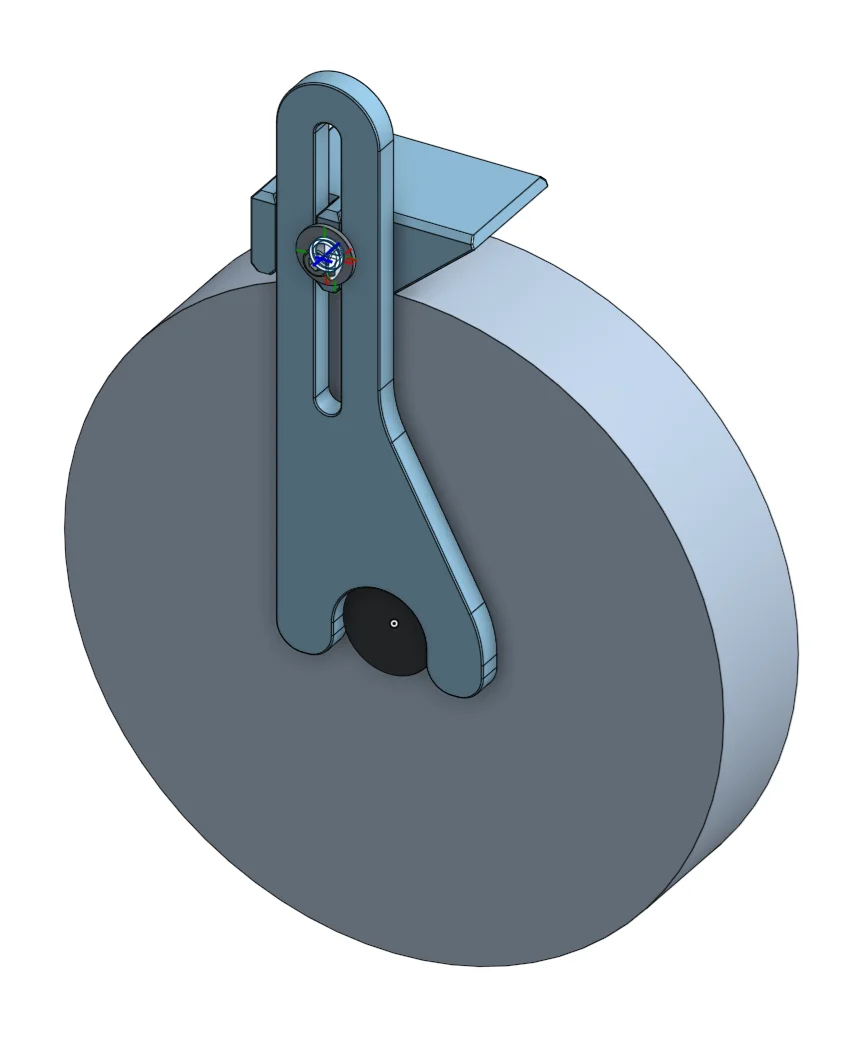
The fork provides an alignment edge through the grinder shaft and centres on the end washer. Use the right fork size for your washer and use the fuller-ed side towards the wheel. This guiding face should be very smooth -- use ironing.
The different angle blocks slide through the slot in the fork. They should support on the grinding wheel with the bottom angled edge. Other chamfered or rounded edges are not as important. The fork aligns this edge with a radial line towards the shaft centre, which makes the bottom face tangential to the wheel. The slot allows this to be true irregardless of the wheel diameter. The tool angle is set by setting the tool against the angled face of the block.
Hardware
Use M6 hardware to mount the blocks to the fork. Use stainless hardware if you don't want it to rust, the Tormek is a water-based grinding system after all...
Long M6 bolt, can be replaced with threaded rod and wingnut (1x should work)
M6 threaded insert (each block)
Fender washer (1x)
Modification (in experimental stage): use a slightly undersized hole and thread a rod into each block.
You may be able to use 1/4-20 hardware (deprecated).
Printing
Print this with a water-resistant polymer. I used PETG, but ABS or ASA should work as well. I used it on my SV06+ with 0.6mm nozzle, and it worked reasonably well. You probably don't need high infill, but you may want to use very thick walls, as they can be sanded down if they need to be smoothed. Generally:
0.2mm layer heights
3 walls (>2mm) - I did 0.65mm + 2x0.8mm
5 top and bottom layers
infill: yes - used 25% gyroid (probably too much for the blocks, I combined it every 2 layers)
Brim - optional?
The fork uses ironing on the top layer (contact between the blocks and the fork)
The blocks have their seams at the back face, where the angle values are displayed.
Extra
I designed this semi parameterised with Onshape.
V1.0: STL's via Printables
V1.1: with smaller holes for threading in bolt/...: https://cad.onshape.com/documents/2b9e783dcd9ae020a2c9b44c/v/27f060a878289795a846c58f/e/94f5e36c25323ef5501f076c?renderMode=0&uiState=6a12e6c1f6d1af335a352a07
BySeppoTakaloLikes960Downloads1.9K

 Byrb_200934Likes48Downloads1.1K

 ByWolf_115355Likes513Downloads8.4K

 ByZED4EverLikes313Downloads5.2K

 ByfifindrLikes500Downloads4K

 ByVC_DesignLikes679Downloads3.6K

 ByKNIN_CustomLikes112Downloads430

 ByDan Schwartz SchwartzLikes744Downloads3.4K

 ByUpcrid3D_1585693Likes808Downloads2.1K

 ByWilko_SLOLikes935Downloads2K

 Bychubbs8697_2027893Likes585Downloads1.7K

 Byquibeck_3353173Likes965Downloads1.9K