



New
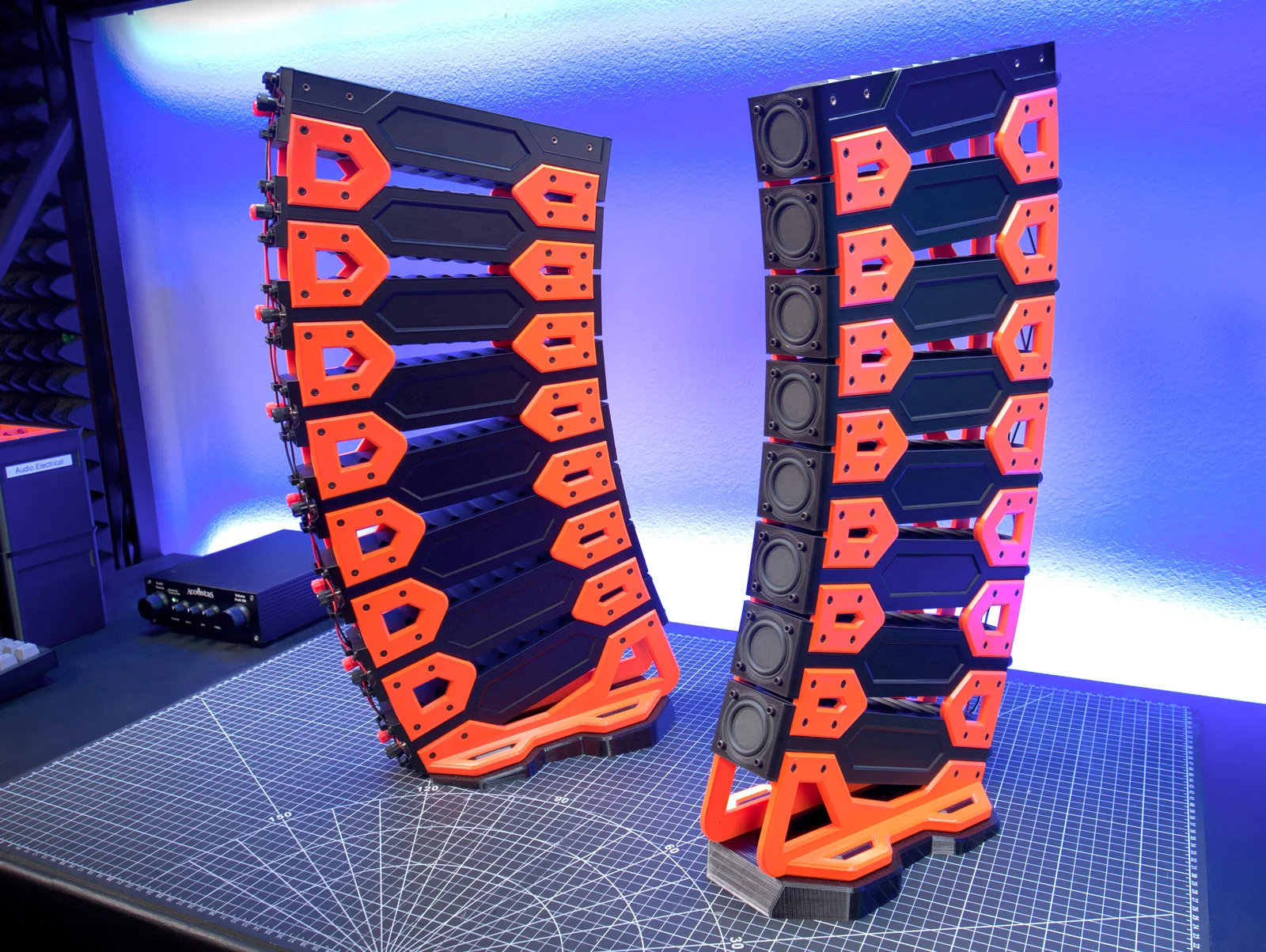
Back Horn Speaker V2.0 BL2 - Bluetooth, Active, Passive
 Bydoc-no-aka-guppykLikes0Downloads178
Build another version of this model.
As seen on X and YouTube:
Designed for use with a single 2" Tectonic balanced mode radiator. Suitable between 100Hz - 18kHz. Larger arrays will accommodate frequencies as low as 70Hz. Use reusable adhesive to seal around everything.
Tectonic 2" BMR:
https://www.parts-express.com/Tectonic-TEBM28C10-4-B-1-1-8-BMR-Full-Range-Speaker-4-Ohm-297-2173
Side (coupler) screws - M3 x 6mm:
https://www.amazon.com/dp/B08B1T2DCD
Front / rear panel screws - M3 x 12mm:
https://www.amazon.com/dp/B08B1W1FHS
M3 x D5 x L4 Threaded Inserts:
https://www.amazon.com/dp/B0CS6VZYL8
Hilitchi Binding Posts Terminals
https://www.amazon.com/gp/product/B07PFMD1N2/
Recommended printing settings:
PLA is okay; PETG is better.
At least 4 perimeters / walls / loops all the way around.
At least 20% gyroid infill. (Higher is better.)
The Micro Modular is designed for indoor use, as the rear-firing vent relies on a bounce from a nearby wall. (The array can sit upwards of a meter from the vent-facing wall without any significant reduction in the mid-bass.) For general listening around the room, use the linear couplers to assemble a “flat” sound bar. For a single focused listening point, use the 700R or the 2000R couplers – depending on how far away you plan to sit. (The 700R couplers project a sound bubble 70cm forward of the arc. The 2000R couplers project a sound bubble 2m forward of the arc.)
Wiring: Literally however you want to, as long as you take care to keep all the drivers in phase. (Just ask your favorite AI how to series/parallel however many of these 3.85 ohm drivers you're using down to your amplifier's rated “stable Ohm load” rating.)
Amplification: The TEBM28C10-4B has a 10W power rating, so 10W x however many modules you're stacking per channel = the approximate amplifier wattage (per channel) to look for.
EQ: As a good starting point, try a steep high-pass filter closer to 100Hz for smaller (4-6 stack arrays,) or closer to 80Hz for larger (8+ stack arrays.) Apply an 8dB 1.12 Q bump at 316Hz, a -10dB 0.61 Q dip at 1.9kHz, and an 11dB 0.4 Q bump at 20kHz.
Once assembled, you'll want to pair the array with a subwoofer capable of reaching 80-100Hz at the high end. If you're considering a 3D printed option, Quad is a good match:
https://www.printables.com/model/1400081-hexibox-series-quad
Note: The focused arrays will still be audible outside the focus point, but with a noticeable high-end roll-off, and a drop in volume. (The more modules you use, the more this effect will intensify.) When paired with a subwoofer, and volume-adjusted for the focus point, anywhere outside of the “sound bubble,” the subwoofer will still be just as loud. So if you're setting this up for someone else, make sure they understand that everyone else still gets to hear the bass portion.
Bydoc-no-aka-guppykLikes0Downloads178

 ByscytLikes0Downloads116

 Bylarp3dLikes0Downloads1.4K

 ByckthLikes148Downloads2.4K

 Byparts-expressLikes0Downloads113

 ByTimSomeCallMeLikes35Downloads250

 By3dwakeLikes0Downloads372

 BylclabLikes0Downloads303

 ByKastnerd_192794Likes21Downloads234

 BynasikLikes0Downloads282


 ByjoranLikes0Downloads219