


Mô hình Rick Roll QR Code Prank - Bảng mã QR troll bạn bè độc đáo
 ByvojtagrecLikes289Downloads901
Build another version of this model.
This model is one of the collection Prêt à Faire: Printable Readymade Models
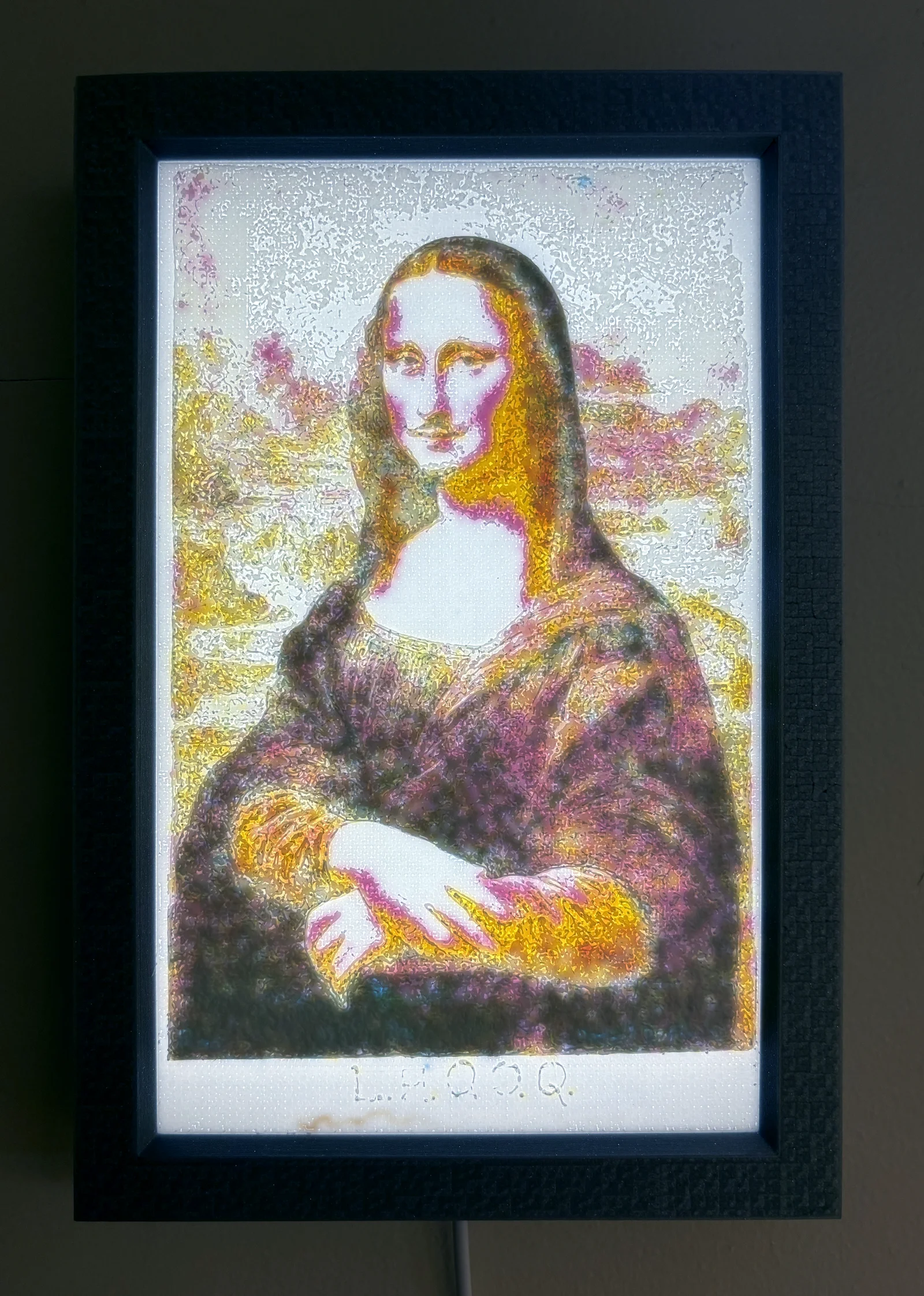
1919 was a fraught year: pandemic, war, social and economic strife. A lot like our own era. It seems appropriate to recognize how history has a way of repeating itself with these lithophane editions of Marcel Duchamp's masterpiece.
Duchamp, loosely affiliated with the Dada art movement at the time, responded to the madness of his era by drawing a moustache on a cheap print of the DaVinci masterpiece Mona Lisa, then scrawling a bawdy word puzzle underneath it as a title.
Much has been written about this seminal, iconic, take-no-prisoners work, but here is a good start for finding out more:
Various editions were created in addition to the original, including but not limited to:
Moderna Museet, Stockholm
1919 original, Paris
Francis Picabia's publication
in 391 no. 12, March 1920
Pompidou Centre
1930 edition, Paris
Stolen, never recovered
1940 edition, Paris
Private collection
1958 edition, Cadaqués
Schwarz edition of 35
1964 edition, Neuilly
Duchamp was not the only artist to toy with da Vinci's masterpiece, and I'm certainly not the only artist who has, in turn, toyed with Duchamp. Examples include:
Eugène Bataille, Le Rire, 2nd ed., 1897
Fernand Léger, Mona Lisa with the Keys, 1930
Andy Warhol, Colored Mona Lisa, 1960
Salvador Dali, Self Portrait Mona Lisa, 1973
Mike Bidlo, NOT Duchamp's LHOOQ, 1987
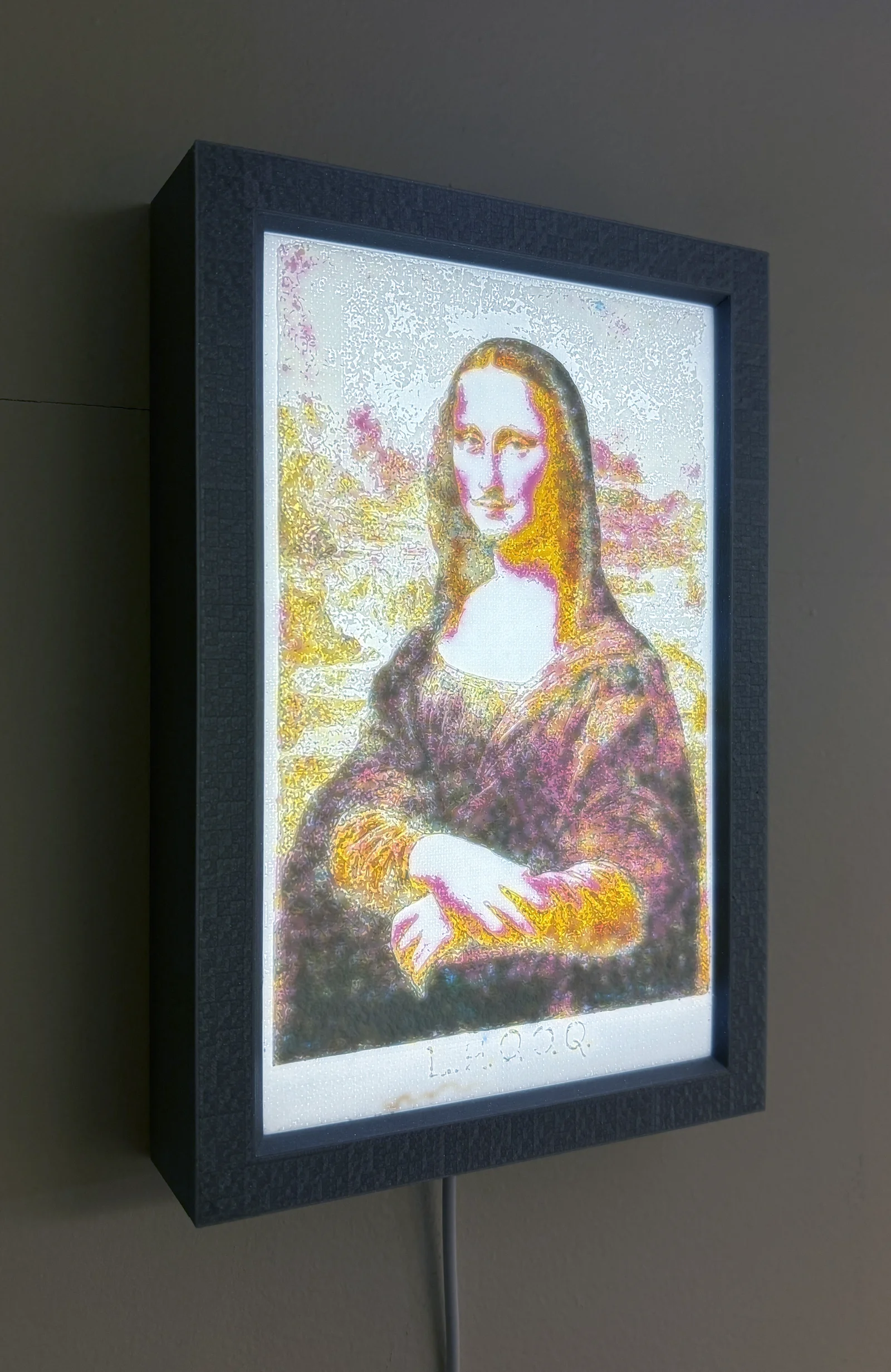
Because each edition has a somewhat unique take on the idea, I've created 3 editions of my own in this publication, presented in lithophane lightbox format, based on:
The original 1919 work, produced at full size
A reproduction printed in the journal 391 by Francis Picabia, produced at full size
A limited edition from 1930, produced at 50% full size
Each one takes advantage of variations in the lithophane creation process and was produced at MakerWorld.
For each edition below, recommended materials include:
Printed Solid Jessie Premium PLA Color Lithophane Bundle (for 1919, 1930)
Creality Beige PLA (for 1920)
Prusament Jet Black PLA (for all lightboxes)
Prusament Galaxy Silver PLA (for frames 1919, 1920)
Amolen Aged Brass Gradient PLA (for frame 1930)
Imdinnogo Lithophane LED Backlight Board kit
Sabrent USB Extension Cable, 3 to 10 feet in length, white
My general settings across all editions:
Print Settings: 0.2mm Structural
Filament: PLA with appropriate profiles for the abovementioned materials
Printer: Prusa XL 5T or MK4/MK3 with MMU
Supports: Paint-on as appropriate
Infill: 15%
Brim: For the plugs, if needed (I printed successfully without)
Advanced settings:
Layers and perimeters: All defaults
Infill: Gyroid fill pattern, Aligned Rectangular top and bottom fill pattern
Support material: Organic style
Special notes:
The original was a washed-out souvenir card Duchamp purchased in Paris. This version is created as a CMYK lithophane. It has a unique proportion, but I've created a custom lightbox and frame that works with a standard LED lightboard fitting the Bambu system. It can be printed on an MK3 or MK4 outfitted with an MMU.
The original frame is in silver leaf and can be emulated with a silver filament
Stats for a full-size print:
Total material used: TBA
Total time: TBA
Total number of build plates: 4
This is a monochrome version of the mock-up created by Francis Picabia for the art journal 391. As a printed version, it provides those without multi-color capability a chance to create one. It can be printed on an MK3 or MK4. You can see a sample of the printed work in the photos - I used a beige filament to create a paper tone similar to the edition, which has faded and turned tan over time. It uses a different custom lightbox and frame, but also works with a standard Bambu fitting for LED lighting.
The original frame is also in silver leaf and can be emulated with a silver filament.
Stats for a full-size print:
Total material used: TBA
Total time: TBA
Total number of build plates: 4
The framed version at the Pompidou Center in Paris will print as a CMYK lithophane on the XL only.
The original frame color can be seen in the photos and can be emulated with a brown filament.
Please note I will be testing these frames and color lithos in the coming weeks, so you are advised to check in for any updates or revisions based on my testing.
Stats for a full-size print:
Total material used: TBA
Total time: TBA
Total number of build plates: 5
Generally, the order of assembly should be clear:
The interior back receives the LED plates, with the cord inserted in the bottom hole. Use an archival tape to keep the LED plates together if they are tricky to work with.
The interior front snaps onto that assembly to secure the LED plates in place.
The lithophane and diffuser are inserted into the notch in the frame. Use an archival clear tape right at the edge to secure them into the notch while assembling. I run tape along the edge so that it overlaps the lithophane ONLY AT the notch, to avoid any chance of seeing it after assembly.
The frame snaps over the interior light box assembly.
Any mitered frame elements are glued to the frame box.
The cord plug is inserted into the hole to secure the cord.
Special case for the 1920 and 1930 assemblies:
The interior backs are printed in one piece
The interior fronts are broken down into a top, 2 sides, and a bottom piece for printing. These must be glued together. Super glue may be used, but I used Gloop for a stronger chemical weld. There are notches on the wall edges to aid with alignment (which also increases the surface area for gluing).
The frame box is similarly broken down and must be assembled the same way.
Use the exploded view in the picture above as a guide for assembly; 1930 is shown, but 1920 is very similar.
On the 1920 lightbox, the fit between the standard Bambu LED plate and the artwork format is awkward. You'll need some reflective material on the angled surfaces to help distribute the light. I used double-sided tape and shiny aluminum foil... use the picture above for reference.
Powered by MakerWorld-Make My Lithophane
12 DEC: Re-wrote the description for clarity and consistent formatting across the Prêt à Faire collection. Added artist precedents to the description. Added an alternative frame for the 1920 to fit smaller printers. Added images of the 1920 model and an exploded isometric view to assist with assembly.
18 OCT: Further revisions on 1930 frame for structure and assembly. Review and update of all lithophanes, with an explicit note for lithophane creation completed at MakerWorld. All lithophanes now carry precise dimensions for frames, with borders 2mm wide and 1mm deep, and should not need further scaling or tweaking. 3mf files are now provided instead of stl files, both for smaller MB size and to provide color separations.
13 OCT: Lightboxes have been completely redesigned for the Bambu standard 48 x 144 daisy-chaining lightbox panels and are light-tight. 1919 frame has been successfully prototyped and can be seen in the photos above. Others to follow, including actual color CMY lithos!
ByvojtagrecLikes289Downloads901

 ByDrewmundLikes833Downloads4.6K

 ByHowler117Likes27Downloads348

 ByVojtechSkals_4144903Likes50Downloads246

 ByFastRaccoon_718321Likes461Downloads1.5K

 ByvexanixLikes168Downloads1.3K

 ByIvoLikes196Downloads1.1K

 Bynonoobybut_3307010Likes364Downloads1K

 ByawelshmanLikes74Downloads136

 ByDorn6_3545870Likes13Downloads117

 ByS1m3DLikes74Downloads115

 ByCodyMeyer_2545340Likes163Downloads724