



Mô hình enzyme Helicase và DNA
 ByKiwis Cant Fly Cant FlyLikes0Downloads2
Build another version of this model.
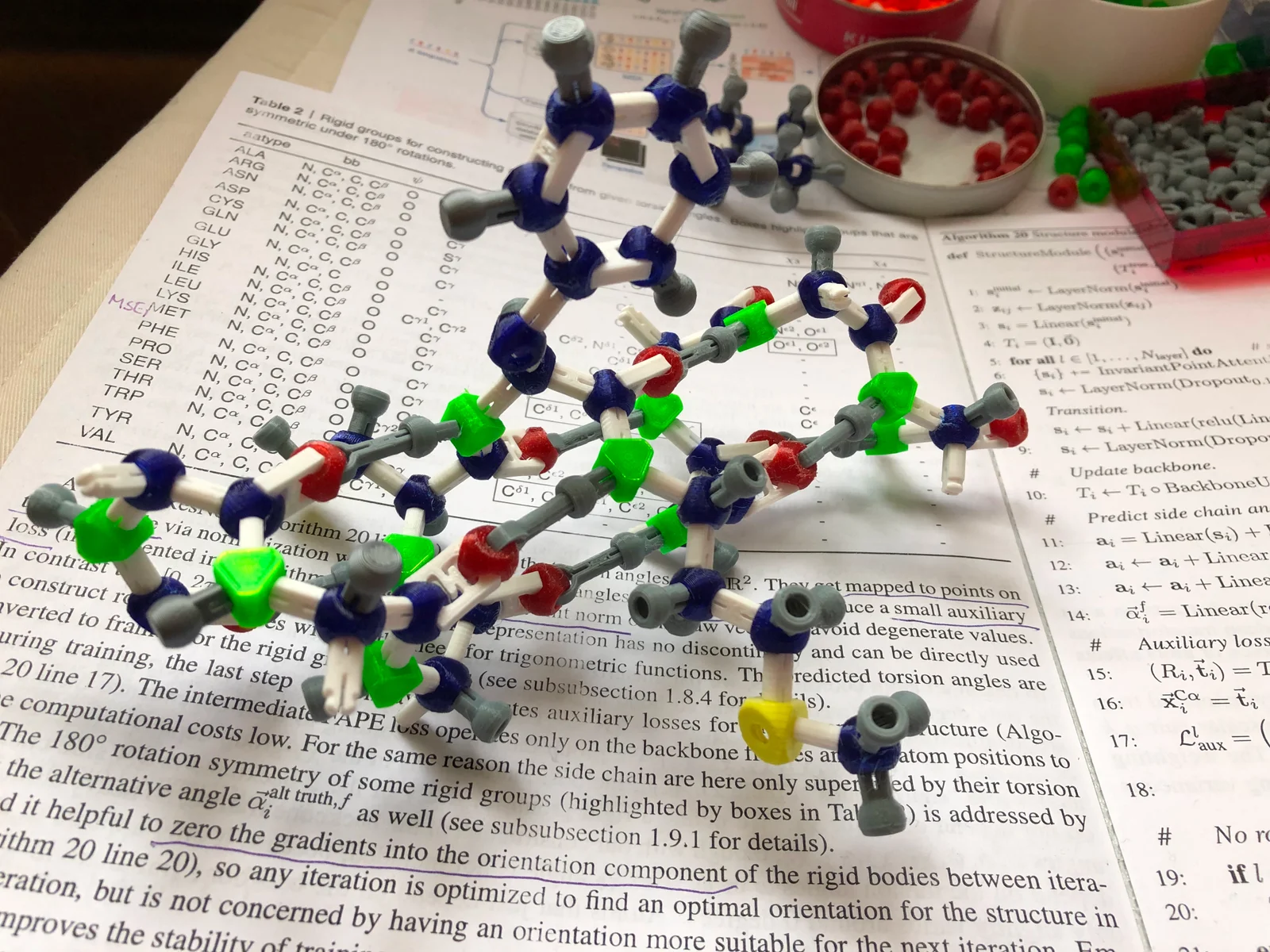
Protein folding kit made especially for better understanding of AlphaFold2 and OpenFold code. Pymol is great but touching macromolecules by hand is better.
Print in PETG without any support or brim. For C+O+Ntetra+P.stl and Hydrogen.stl set plate 5 degrees hotter than default for the first layer.
It takes few days to print a reasonable kit but things you can learn with it are worth it!
The stl files contain single pieces of the kit - you likely want to start with these to test things out.
I also added some gcode files with many repeated elements - these are not complete at the moment…
I designed it in FreeCAD - if anybody is interested in the design files, let me know, it may speed up my cleanup of these files for public use :)
I will likely add few more components as I build my biochemical models and discover what else I need.
Printing tips
Click-in parts (bonds) need PETG, do not try PLA for these, it will break soon. (Maybe PLA would be OK for atoms.) When printing many small PETG parts, brim is quite a nuisance (hard to remove from parts) so I print without brim. Bead-shaped atoms are easy to get off the plate after print so maximize adhesion to make sure each of them sticks and stays at place during print:
For the bonds, you may need to experiment a bit as getting these off the plate is harder, especially for double bonds.
How to use the model
Carbon atom (C+O+Ntetra+P.stl) is a regular tetrahedron, single bonds (bond-single.stl) can connect it to other atoms. The single bond clicks in quite firmly, use the tool (tool.stl) to get it in. (Keep atom in tetrakeep.stl.) It can hold quite big molecules in shape but can also be rotated. The double bond (bond-double.stl) does not rotate.
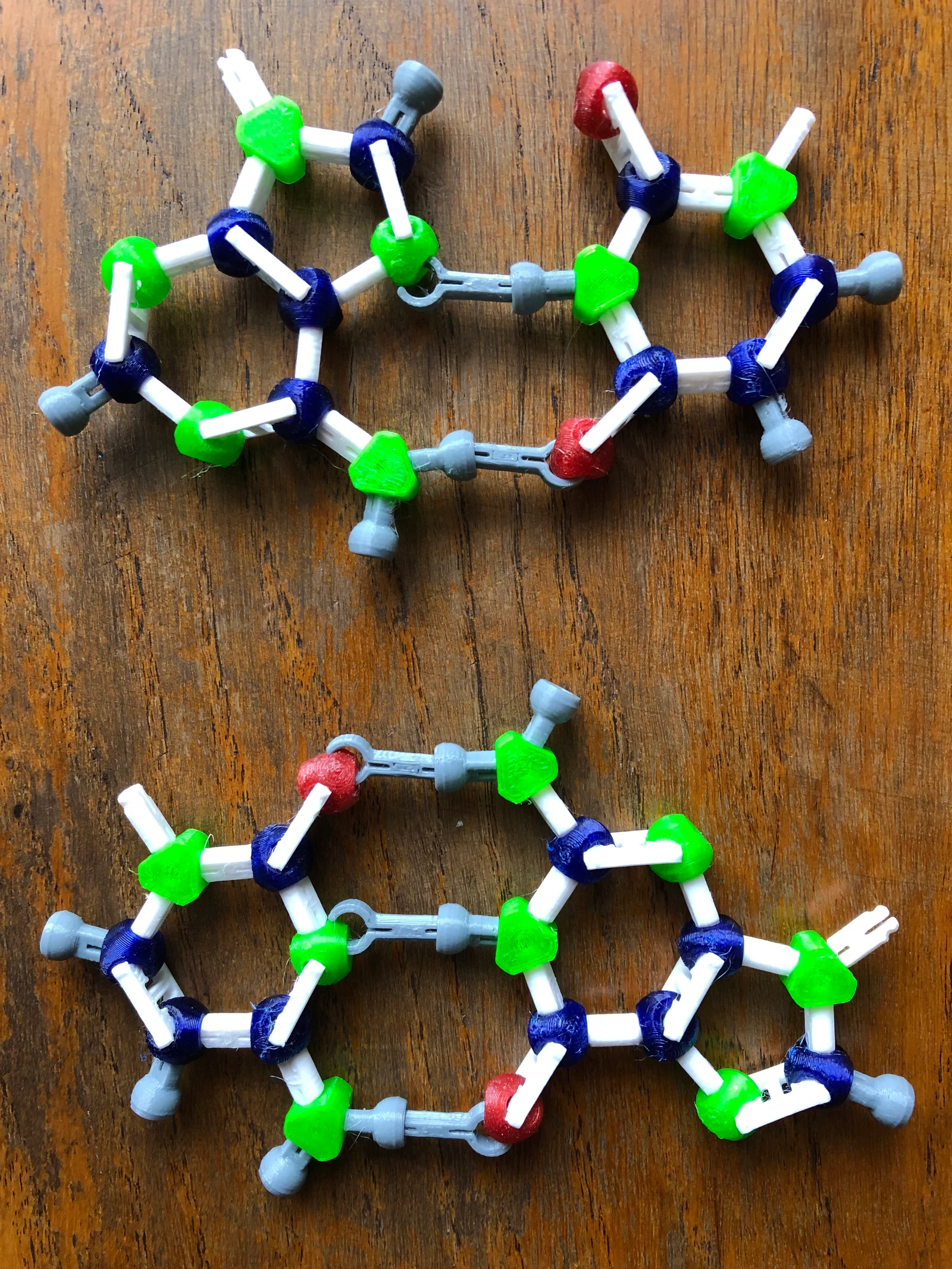
Oxygen atom shares the form with Carbon, pushing in two Hydrogen (Hydrogen.stl) atoms makes sort-off realistic water molecule (the angle is just slightly off). The remaining holes in oxygen model can be used for hydrogen bond (bond-H.stl), see pictures with alpha helix and paired RNA bases.
Nitrogen can either use the carbon form (pushing in three hydrogens makes ammonium, pushing in four hydrogens makes an ammonium cation) or a special model with 3 holes 120 degrees apart (Nitrogen-tri.stl, with tool trikeep.stl) - choose the right one depending on the molecule.
Even Phosphorus uses the carbon tetrahedral form but there is a special 1-to-2 bond (bond-double-P.stl) which can e.g. bind one of the four oxygen atoms in ATP, fitting one hole in phosphorus and two holes in oxygen.
Sulfur has a special form (Sulfur.stl), also with four holes but two of these are nearly right angle apart and can e.g. be used with two special 1-to-2 bonds (bond-double-P.stl from the ATP example above) to build a sulfuric acid model (see it in photographs).
In a peptide backbone, the middle ‘single’ bonds in C_alpha-C-N-C_alpha have one strongly preferred dihedral angle which can be enforced by the part antirotator.stl.
Alternatively, you can build peptide backbone using part bond1double1.stl for that non-rotating single bond, use Nitrogen-tri.stl shape for a carbon and bind oxygen to it with bond-double-P.stl. You can also build nicer aromatic cores using three bond1double1.stl parts, three single bonds and six carbons with shape Nitrogen-tri.stl.
ByKiwis Cant Fly Cant FlyLikes0Downloads2

 ByBoonby_1059917Likes659Downloads1.2K

 Bybenchyboi_3128828Likes0Downloads2

 By3DMinter_1241559Likes1Downloads2

 ByProtspace_3482274Likes10Downloads19

 ByFabianVeileLikes414Downloads1.5K

 BygillisLikes121Downloads2.1K

 ByDavydabeast_3194764Likes0Downloads1

 ByJonetin_3703707Likes4Downloads5

 ByMarciLikes87Downloads293

 Bystrifu_4061046Likes151Downloads1.3K

 ByStobbartLikes15Downloads52