



HappyPaws Pet Bowl
 BywoxelLikes0Downloads121
Build another version of this model.
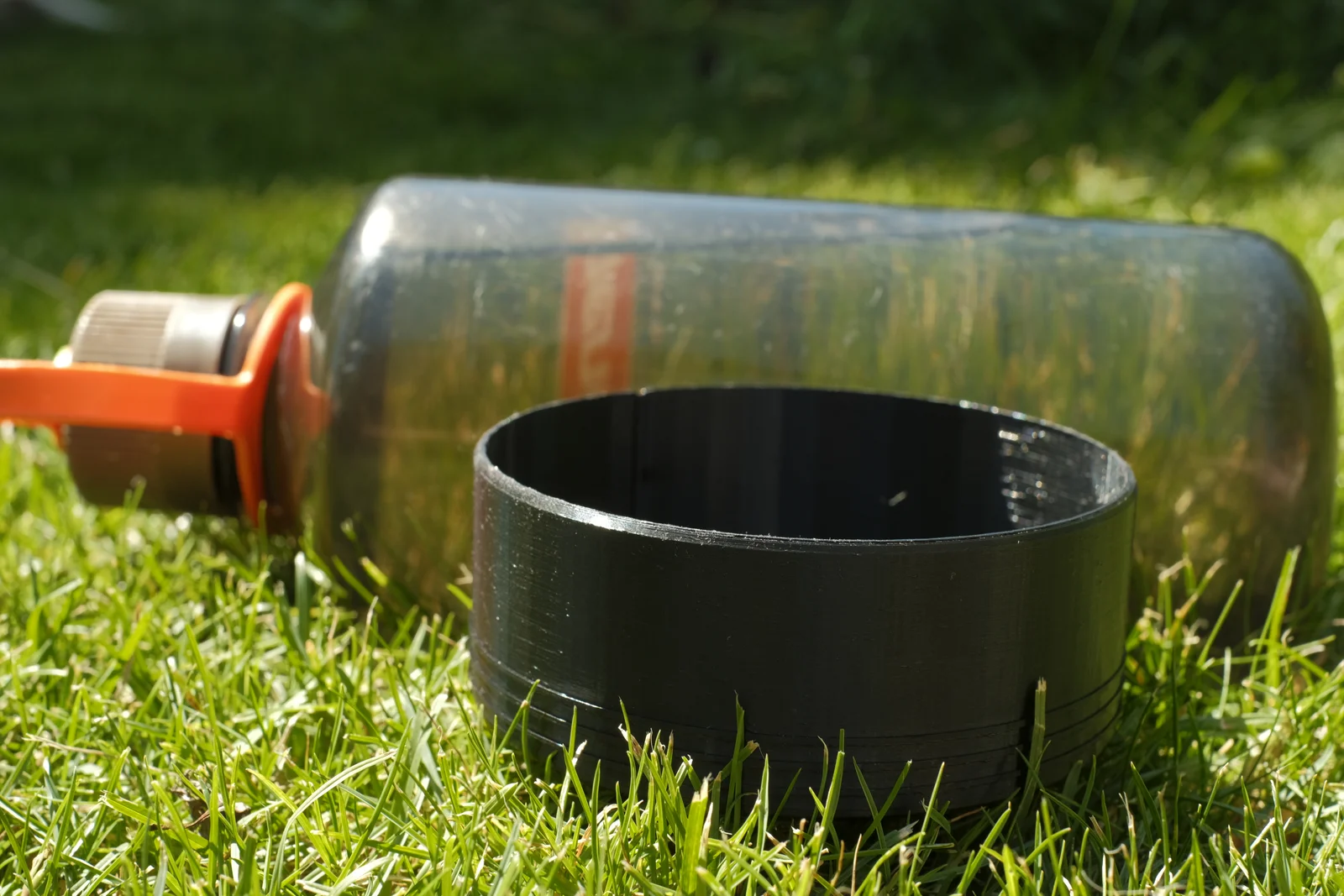
Dog Drinking Bowl for 1L Nalgene Bottles — Version 0.9 Prototype
I designed a compact dog drinking bowl that can be attached to the bottom of a standard 1L Nalgene bottle. 1.5L Nalgene bottles also fit, since they have the same diameter.
The bowl is not limited to original Nalgene bottles. Of course, it should also fit compatible bottles or Nalgene-style derivatives with the same bottom diameter. Since there are now many bottles with this size, the bowl may also work with other compatible models.
The idea behind this project was to create a compact and practical solution for being outdoors with a dog. I have used collapsible bowls before, but often found them unstable or inconvenient. I also always had to take both the bottle and the bowl out of my backpack. After use, the wet bowl then had to be stored inside the backpack or attached to the outside with a carabiner, which was not a good option for me.
For a while, I also used a dog water bottle with an integrated bowl. However, what bothered me was that I then had to carry a second bottle in addition to my own drinking bottle.
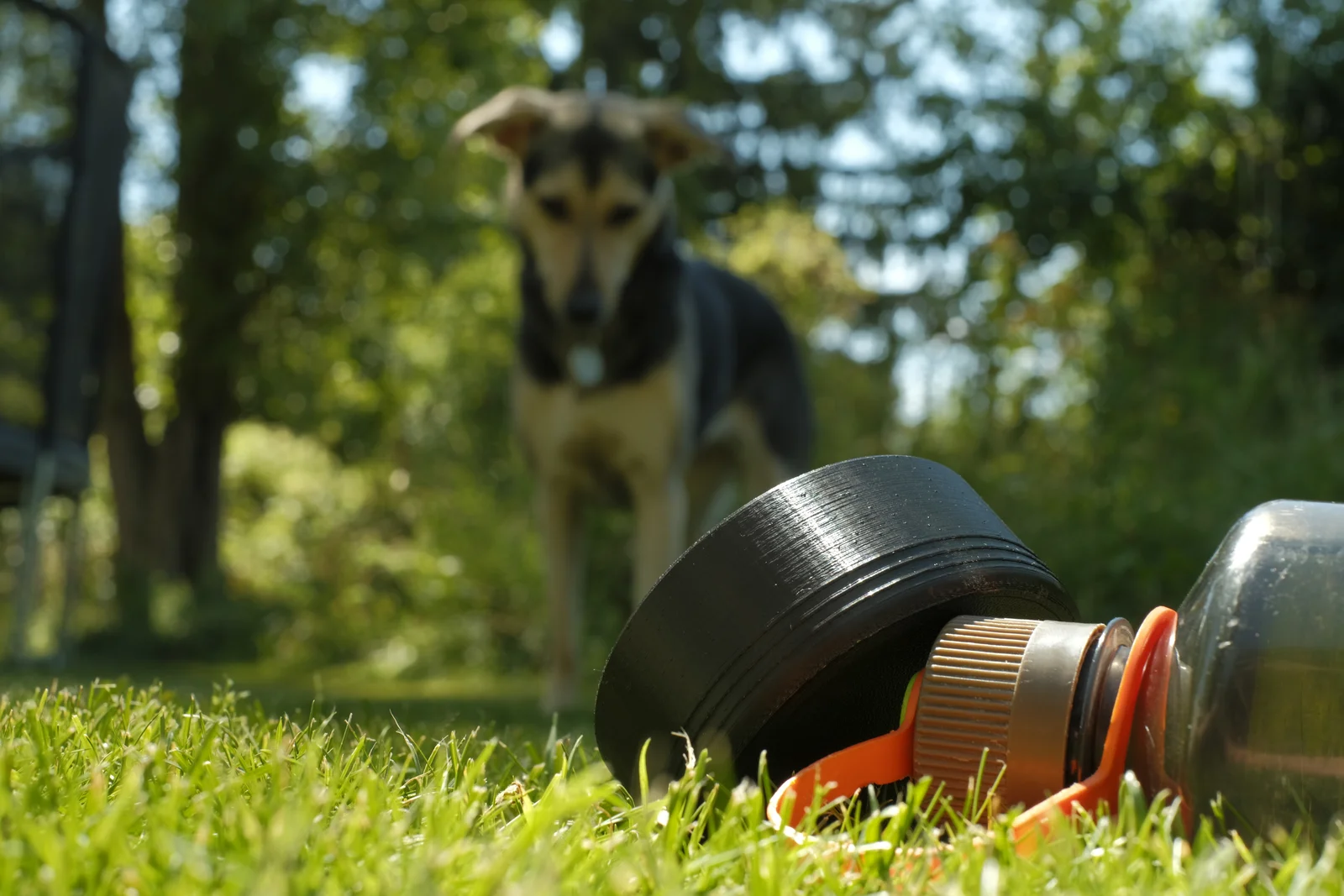
Since I could not find a solution that really worked for me, I designed this bowl. It simply attaches to the bottom of the bottle. This means that during a break I can give my dog water and drink from the same bottle myself, without handling two bottles or searching for a separate bowl.
After use, the bowl is simply attached back onto the bottle, and both can be transported together in the outer mesh pocket of a backpack.
For me, this has been the most practical solution so far.
Current Status
This model is currently still a prototype, Version 0.9. It already works well in principle, but should not be considered a final version yet.
Feedback, improvement suggestions, and reports about other compatible bottles are always welcome.
Fit
The bowl is held on the bottle by a light suction/press fit and sits relatively securely.
To prevent trapped air when attaching the bowl, and to avoid vacuum issues when removing it, the design includes two small ventilation channels.
There are three different fit variants:
Tight Fit — 93.0 mm inner diameter
The version I tested first. It sits quite firmly on all my bottles.
Wider Fit — 93.2 mm inner diameter
A slightly looser version that should be easier to attach and remove while still holding securely.
Loose Fit — 93.5 mm inner diameter
The easiest version to attach and remove. Recommended if your printer, filament, or bottle makes the other versions too tight.
_Since printers, filaments, and bottles can all have slightly different tolerances, it makes sense to choose the version that works best for your setup.
_
Handling
The outside of the bowl has three raised grip rings. This makes it easier to hold and remove the bowl, even with wet fingers or gloves.
After use, the bowl can simply be shaken out briefly and attached back onto the bottle. Of course, some residual moisture may remain inside the bowl. For outdoor use, this is not a problem for me, since the bottle and bowl are then transported together in the outer mesh pocket of the backpack.
At home, the bowl should be cleaned together with the drinking bottle and allowed to dry completely.
Material and Printing
I printed the bowl in PETG and have not had any problems with it so far. Other food-safe materials should likely work as well.
I would not recommend PLA, as it may deform at summer temperatures, for example in a car or in direct sunlight.
Cleaning
After use, the bowl should be rinsed and cleaned regularly with warm water, dish soap, and a small brush.
To remove odors, limescale, or light residue, the bowl can occasionally be wiped with diluted vinegar essence. Afterwards, rinse thoroughly with clean water and allow it to dry completely.
Vinegar essence should not be used undiluted. A dilution of about 1 part vinegar essence to 5–10 parts water is usually sufficient.
Note: For contact with drinking water, not only the filament but also the entire printing process should be as clean as possible. This includes, for example, a clean nozzle, suitable print settings, and thorough cleaning after printing.
BywoxelLikes0Downloads121

 ByPavelBures_1259148Likes16Downloads56

 ByowlartLikes24Downloads139

 BybobmakesLikes2.5KDownloads17.5K

 Bythreed-michaelLikes0Downloads224

 ByfifindrLikes216Downloads604

 Byquibeck_3353173Likes1.5KDownloads11.5K

 By178222178222_2484344Likes449Downloads1.7K

 ByVaclav_ZahradkaLikes181Downloads1.2K

 ByMateuszTokarzLikes46Downloads299

 ByDrJonesLikes320Downloads832

 Bym-collectableLikes0Downloads3.9K