



Bộ xúc xắc khổng lồ (Complete Giant Dice Set)
 BybobmakesLikes4.3KDownloads16K
Build another version of this model.
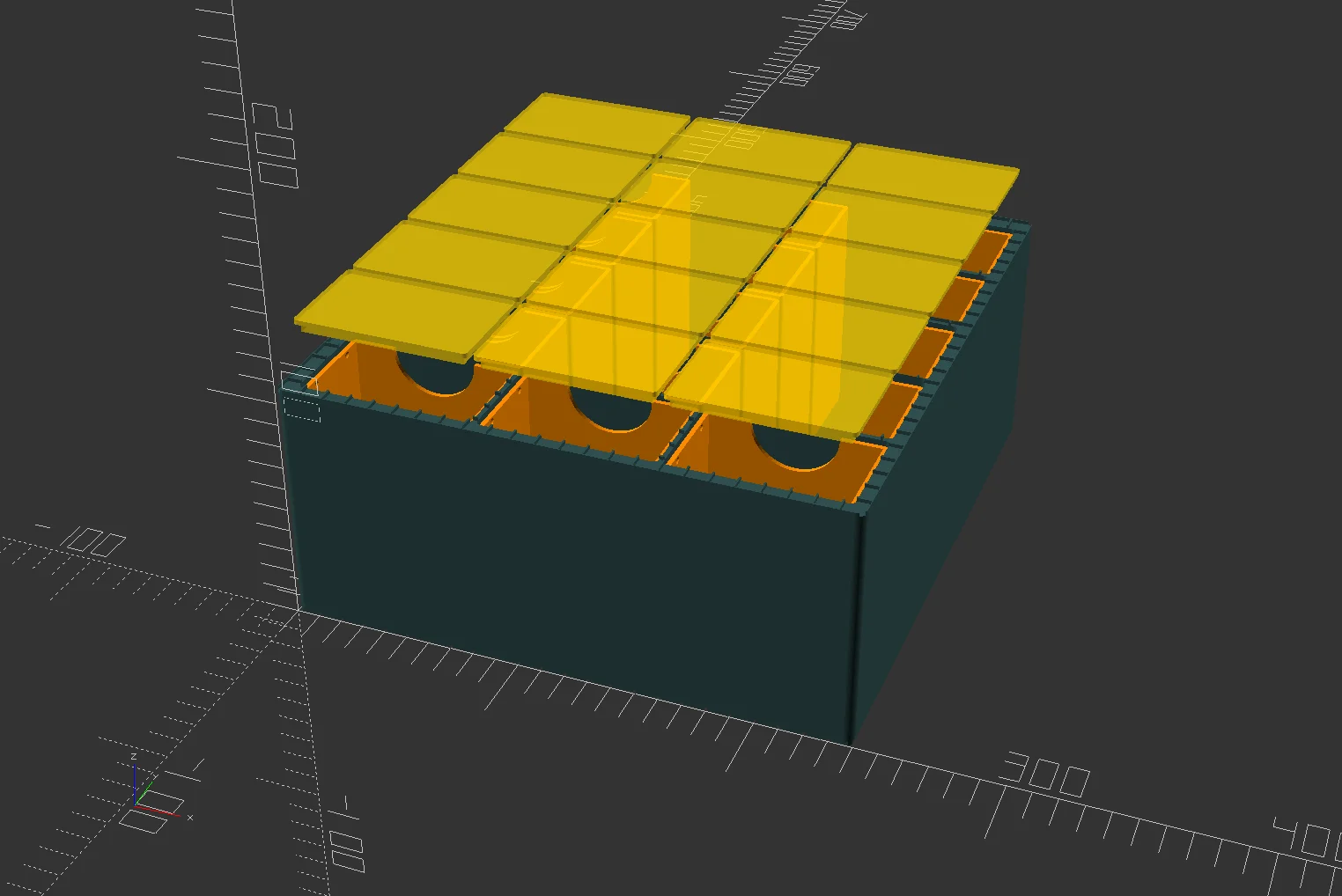
This is a parametric storage system for trading card games, designed in OpenSCAD. Instead of downloading a fixed STL, you open the .scad file, type in how many cards each of your decks has, and the whole system generates itself:
Individual deck cases
Each case is sized to its exact card count — a 20-card side deck gets a slim case, a 60-card main deck gets a full-size one.
Snap-fit lids with ball detents. The number and position of the snap balls adapts automatically: long cases get two, short cases get a single centered ball.
Finger cutouts on both ends for easy opening.
Master box (outer shell)
Holds all your deck cases in a column/row layout you define (up to 5 columns, any number of decks per column).
Adaptive push-out cutouts in the floor under every slot — sized to the slot, so even the thinnest deck case can be pushed out from below.
Lids sit recessed below the rim, so nothing sticks out.
Grid stacking system
Master box dimensions are quantized to a common grid module (10 mm by default). The top of each box carries small locating ridges along the grid lines; the bottom carries matching grooves.
Because every box is a whole multiple of the grid, boxes of different sizes interlock in any combination — e.g. one large box on the bottom with two smaller ones locked on top, Gridfinity-style.
A classic single-perimeter-lip mode is also included if you only stack identical boxes.
How to customize
Open the .scad file in OpenSCAD (free, openscad.org) and open the Customizer panel.
In the Layout section, fill in row_1 … row_5. Each row is one column of the box; each number is the card count of one deck. Example: row_1 = [60, 20], row_2 = [40] gives two columns — one with a 60- and a 20-card case, one with a single 40-card case.
Card dimensions default to sleeved standard-size cards (66 × 91 mm footprint) — adjust card_w, card_h, card_thickness for your sleeves.
Switch render_mode to Print to get all parts laid out flat on the plate, then render (F6) and export the STL.
Key tuning parameters
printer_tolerance — global fit between deck cases and the master box (default 0.25 mm)
snap_r — ball snap size; groove_clearance — stacking fit (default 0.2 mm per side)
grid_pitch — stacking grid module; must be identical across all boxes you want to stack together
No supports needed. The Print render mode already lays every part in its correct orientation: the master shell on its base, deck cases opening-up, lids flat-side-down with the plug and snap balls pointing up.
Setting
Recommendation
Material
PLA or PETG (PETG for a bit of flex in the snap lids)
Layer height
0.2 mm (0.16 mm for nicer snap balls)
Perimeters
3
Infill
10–15 % gyroid/grid
Supports
None
Brim
Optional for tall deck cases on textured sheets
Fit tuning:
Deck cases too tight/loose in the master box → adjust printer_tolerance in ±0.05 mm steps.
Lids snap too hard or too weak → adjust snap_r by ±0.1 mm (the sockets scale with it).
Stacked boxes wobble or won't seat → adjust groove_clearance (lower = tighter).
The small snap balls print best with slower speeds on outer walls; a 0.4 mm nozzle handles them fine.
Tip: print one small test box first (e.g. row_1 = [20]) to dial in tolerances for your printer before committing to a large master box.
Remember: all master boxes that should stack together must be generated with the same grid_pitch.
BybobmakesLikes4.3KDownloads16K

 ByZenBedlam_2902695Likes0Downloads1

 ByNickR_504962Likes33Downloads166

 Byewr2sanLikes208Downloads817

 ByMZ4250Likes147Downloads911

 ByFishManooo_1312296Likes172Downloads588

 Byrezips_533396Likes52Downloads391

 BySascha_LB_581517Likes87Downloads482


 ByKNfLrPnLikes45Downloads220

 ByJoe_84156Likes38Downloads241

 Byvampyre_1939586Likes2Downloads3