



Marci's Mount - Ngàm in 3D cho kính thiên văn Hadley
 ByMarciLikes87Downloads296
Build another version of this model.
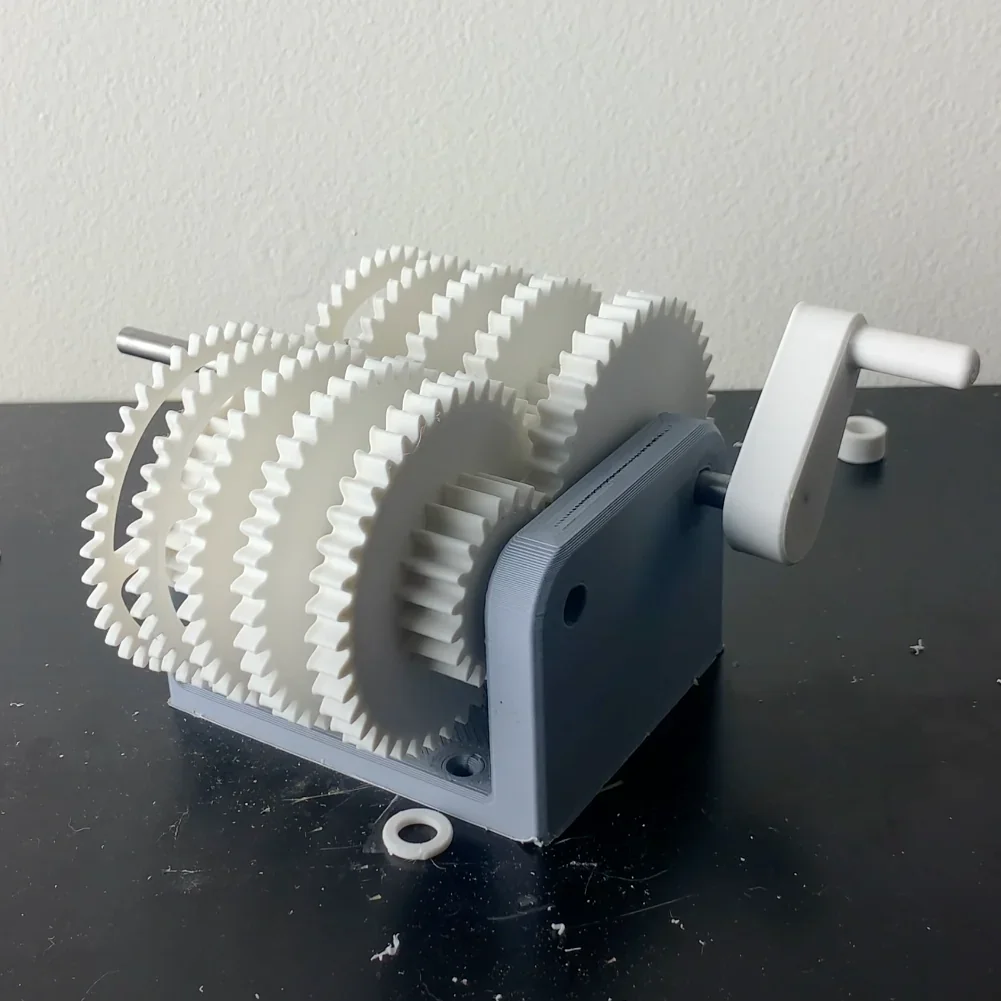
This device is a specialized 1:512 Speed Multiplier gearbox - it is for experimental uses where a user requires a high rate of rotation from a slow input source, like a hand crank or a motor that produces high torque at low revolutions.
To understand the operation, it is important to note that this gearbox converts torque into speed. In a standard gearbox, the output power increases but this device functions differently.
For every single rotation at the input, the output shaft completes 512 rotations. Because the mechanical disadvantage is high, the device requires a high amount of torque to begin moving. As stated in "back-heavy", the friction inside the mechanism is a significant factor that resists motion.
To achieve the best results, you should use specific settings during the printing process. When you select a filament for the internal gears, Nylon or POM are suitable because they have a low coefficient of friction. PETG is another option that is functional. By contrast you should use PLA+ or PETG for the housing because those materials are stiff and do not bend easily. It is important that you do not use standard PLA for the high speed gears, as the heat from friction can cause the plastic to become liquid.
If you set the layer height, 0.12mm is the necessary value - at this level of detail, the teeth are accurate, which prevents the gears from getting stuck. For the infill a 100 % concentric pattern is required. With this setting, the gears are solid and the weight is distributed equally from the center, which allows them to withstand outward forces during rotation. On the walls you should use 4 or more layers - this ensures that the teeth are attached to a base that is firm. And finally you must place the gears flat on the print bed. If you do this the teeth are strong and can resist breaking.
ByMarciLikes87Downloads296

 Bystrifu_4061046Likes151Downloads1.3K

 ByBoonby_1059917Likes659Downloads1.2K

 ByFabianVeileLikes414Downloads1.5K

 BygillisLikes121Downloads2.1K

 ByLat0102_256421Likes35Downloads139

 Byloykastj_145194Likes1Downloads64


 ByzoltanfLikes73Downloads278

 Byleizerdesign_249154Likes62Downloads802

 ByHonzalLikes246Downloads181
