


Giá đỡ điện thoại cho kính hiển vi (Microscope Phone Holder)
 Byleizerdesign_249154Likes62Downloads799
Build another version of this model.
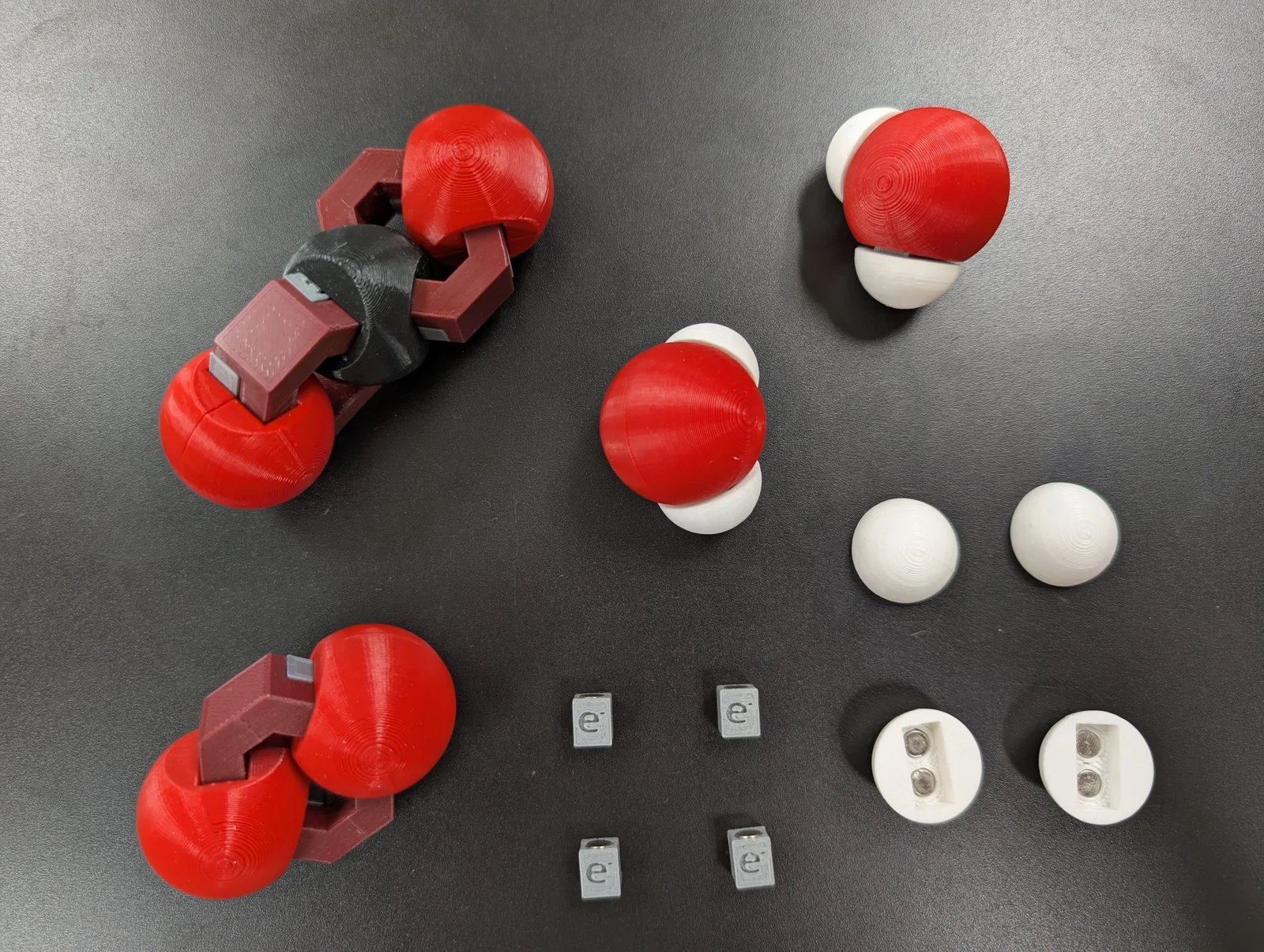
These models incorporate 5x3mm and 5x2mm disc magnets to allow for electrons to connect atoms together to form molecules. Each bond is formed by using two electrons, representing a covalent bond. This allows for the construction of a variety of organic and inorganic molecules, but most usefully can be used to model the movement of electrons in redox reactions.
The electrons should be embedded with two 5x3mm disc magnets, oriented with the same pole (I use the South pole for electrons) oriented outward. Oxygen and carbon atoms should be embedded with 5x3mm magnets oriented with the opposite pole relative to the electron's magnets (I use the North pole for the atoms) facing outward. Hydrogen atoms should be embedded with 5x2mm atoms, again with the opposite pole relative to the electrons facing outward. This allows the electrons to connect any two atoms together in a covalent bond.
The bonds can be used to create double bonds, like when forming O2 or CO2 molecules. The double bonds should use 5x2mm disc magnets, but the orientation is a little tricky. The magnets embedded on the protruding pegs of the bonds should be the same orientation as the electrons, since these magnets will connect directly to atoms. The magnets embedded on the non-protruding parts of the bonds should be in the same orientation as the atoms, since these magnets will connect to electrons that also connect to atoms. The reason the double bonds are structured in this way is to reflect how these bonds are still covalent - they incorporate two shared electrons in each bond.
When used with NAD+ and FAD models, these can be used to track the inputs and outputs of the light reactions of photosynthesis and the inputs and outputs of the electron transport chain of aerobic cellular respiration.
Byleizerdesign_249154Likes62Downloads799

 ByBoonby_1059917Likes659Downloads1.2K

 ByFabianVeileLikes414Downloads1.5K

 BygillisLikes121Downloads2.1K

 ByMarciLikes87Downloads292

 Bystrifu_4061046Likes151Downloads1.3K

 ByStobbartLikes15Downloads49


 ByzoltanfLikes73Downloads271


 ByHonzalLikes246Downloads175

 ByKavelry3D_844921Likes5Downloads30